
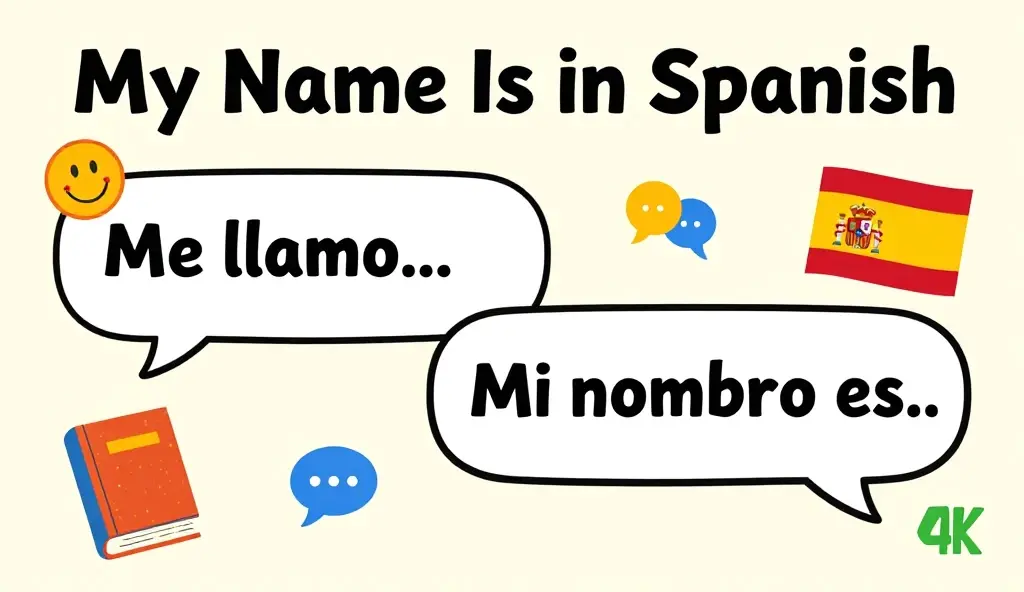
If you’re learning Spanish, traveling to a Spanish-speaking country, or introducing yourself to new people, one of the first phrases you’ll need is “My name is” in Spanish.
It’s a simple expression, but it’s also one of the most common and useful greetings in everyday conversations.
Here’s the thing… there are two natural ways to say your name in Spanish.
One is more traditional, while the other is the most common in modern conversation.
Knowing both will help you sound more confident and communicate naturally with native speakers.
In this guide, you’ll learn how to say “my name is” in Spanish, when to use each phrase, pronunciation tips, and common examples.
🗣️ How to Say “My Name Is” in Spanish

The two most common translations are:
- 🇪🇸 Me llamo — I call myself (the most natural everyday expression)
- 👤 Mi nombre es — My name is (more formal or direct)
Examples:
- 😊 Me llamo Carlos. — My name is Carlos.
- 🌸 Me llamo Sofia. — My name is Sofia.
- 👤 Mi nombre es David. — My name is David.
- 🌟 Mi nombre es Isabella. — My name is Isabella.
📖 When to Use “Me Llamo”
Me llamo is the phrase you’ll hear most often.
It’s commonly used:
- 👋 When meeting someone new
- 🏫 In school introductions
- 🌍 While traveling
- 💼 During casual conversations
- ☕ At social gatherings
- 🎉 At community events
- 📚 In Spanish classes
- 🛫 At airports
- 🏨 When checking into hotels
- 🤝 During friendly introductions
- 💬 In everyday speech
- 📱 In language-learning apps
- 🌎 Across most Spanish-speaking countries
- 🎓 In beginner Spanish lessons
- ✨ In natural conversations
- 😊 With new friends
- 🧳 During vacations
- 🎭 At cultural events
- ❤️ In family introductions
- 📖 In textbooks
- ⭐ Almost everywhere
💡 When to Use “Mi Nombre Es”

This version is also correct but sounds slightly more formal.
You might use it:
- 📄 On official forms
- 🎤 During presentations
- 💼 Professional introductions
- 🏢 Business meetings
- 🎓 Formal speeches
- 📚 Classroom presentations
- 📰 Interviews
- 🎥 Recorded introductions
- 🎭 Public speaking
- 📖 Written biographies
- 👔 Job interviews
- 🌍 International conferences
- 🤝 Formal networking
- 📝 Official documents
- 🎙️ Podcasts
- 📺 Television appearances
- 🏆 Award ceremonies
- ✨ Professional settings
- 📋 Registration events
- 💬 Formal conversations
- 🌟 Special occasions
🔊 Pronunciation Guide
Here’s how to pronounce each phrase:
- 🗣️ Me llamo → meh YAH-moh
- 👤 Mi nombre es → mee NOHM-breh ess
Tips:
- 🎧 Listen to native speakers
- 📚 Practice daily
- 🗣️ Repeat aloud
- 😊 Speak naturally
- 🎯 Focus on clear pronunciation
- 🌎 Learn regional accents
- 🎵 Watch Spanish videos
- 🎤 Practice with friends
- 📱 Use language apps
- ✨ Build confidence
🌍 Other Helpful Spanish Introduction Phrases

After saying your name, you can continue the conversation.
- 👋 Hola — Hello
- 😊 Mucho gusto — Nice to meet you
- 🤝 Encantado/Encantada — Pleased to meet you
- ❓ ¿Cómo te llamas? — What’s your name?
- 💬 ¿Cómo estás? — How are you?
- 👍 Estoy bien. — I’m fine.
- 🌎 Soy de Estados Unidos. — I’m from the United States.
- 🎓 Estoy aprendiendo español. — I’m learning Spanish.
- ❤️ Gracias. — Thank you.
- 👋 Adiós. — Goodbye.
❓ FAQs:
1: 🇪🇸 How do you say “My name is” in Spanish?
A: The most common expression is “Me llamo.”
2: 👤 Is “Mi nombre es” correct?
A: Yes. It also means “My name is” and is slightly more formal.
3: 🗣️ Which phrase do native speakers use most?
A: Most native speakers say “Me llamo.”
4: 🌎 Is the phrase the same in all Spanish-speaking countries?
A: Yes, although accents and pronunciation vary.
5: 🎓 Which phrase should beginners learn first?
A: “Me llamo” is usually taught first because it’s the most common.
6: 📚 What does “Me llamo” literally mean?
A: It literally means “I call myself.”
7: 💼 Is “Mi nombre es” formal?
A: Yes. It often sounds more formal than “Me llamo.”
8: 😊 Can I use either phrase?
A: Yes. Both are grammatically correct.
9: 🎤 How do I ask someone’s name?
A: Say “¿Cómo te llamas?”
🏁 Conclusion:
Learning how to say “my name is” in Spanish is one of the first and most useful steps in speaking the language.
While “Me llamo” is the expression you’ll hear most often in everyday conversations, “Mi nombre es” is also correct and works well in formal situations.
Practice both phrases, use them with confidence, and you’ll be ready to introduce yourself if Spanish is spoken.

Harper Collins is a professional creative writer from Boston, USA, specializing in unique baby names, stylish nicknames, and modern branding inspiration for online audiences.