
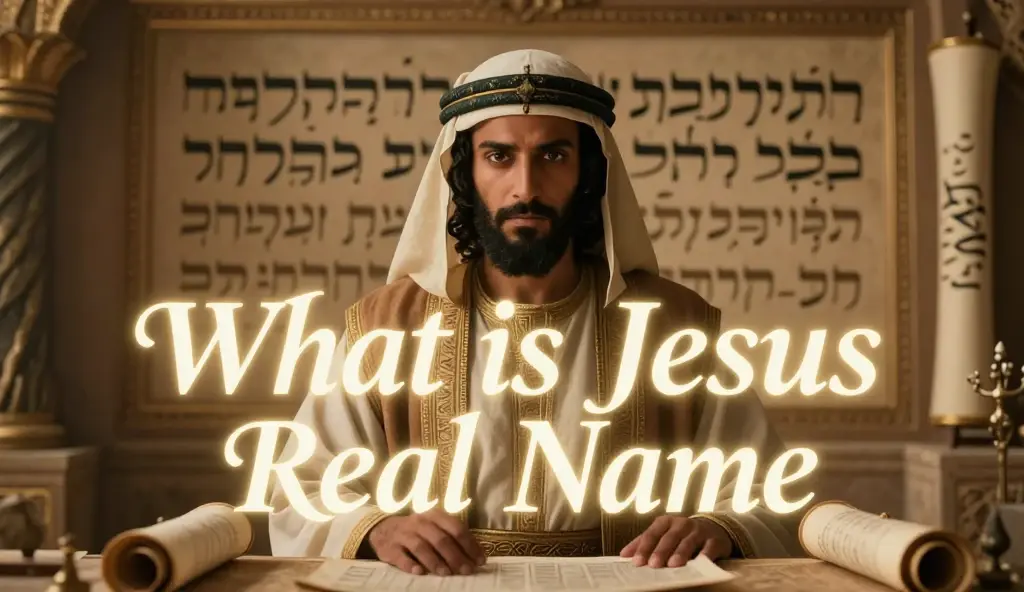
The question “what is Jesus real name” is one of the most searched topics in religion, history, and language studies.
Millions of people know him as Jesus, but very few realize that this name has gone through centuries of translation, cultural change, and linguistic evolution.
Here’s the thing… the name “Jesus” is not what he was originally called in his lifetime.
It is a later English version of an ancient Hebrew name that carried deep meaning in Jewish culture.
Understanding Jesus’ real name helps us see history more clearly — how languages shift, how cultures influence religion, and how one of the most important figures in human history was actually known in his own time.
In this guide, you’ll learn his original name, what it meant, how it changed over time, and why it still matters today.
✡️ What Was Jesus’ Real Name?

Jesus’ historical name was:
👉 Yeshua (ישוע)
This was a common name in 1st-century Judea.
It comes from a longer Hebrew form:
👉 Yehoshua (יהושע)
Meaning:
- ✨ “God saves”
- ✨ “The Lord is salvation”
- ✨ “Yahweh is deliverance”
So when people ask “what is Jesus real name,” the most accurate answer is Yeshua.
🌍 How the Name Jesus Changed Over Time
Let’s break down the transformation step by step:
- ✡️ Hebrew/Aramaic: Yeshua (ישוע)
- 🇬🇷 Greek: Iēsous (Ἰησοῦς)
- 🏛️ Latin: Iesus
- 🇬🇧 English: Jesus
But wait… here’s the key insight:
Each language adjusted the sound to match its own pronunciation system.
So “Jesus” is not a new name — it is a translated form of Yeshua.
📜 Why Was the Name Changed?

The name changed mainly because:
- 📖 The New Testament was written in Greek
- 🏛️ Greek had no exact “sh” sound like Hebrew
- 🔤 Translators adapted pronunciation
- 📚 Latin later standardized the spelling
- 🇬🇧 English simplified it further
- 🌍 Global Christianity spread the English form
- 🕊️ Religious texts influenced naming traditions
- 📜 Historical language shifts over centuries
- 🧠 Cultural translation differences
- ✝️ Church adoption of Latin Bible texts
- 🌎 Expansion of Christianity worldwide
- 🏛️ Roman Empire language dominance
- 📖 Manuscript copying variations
- 🔊 Sound adaptation across languages
- 🏺 Ancient scribal practices
- 📚 Scholarly translation choices
- 🌿 Regional dialect influence
- 🧾 Early Bible translations
- 💬 Oral tradition pronunciation changes
- 🔤 Alphabet limitations in Greek and Latin
- ✨ Evolution of religious language
✡️ What Does “Yeshua” Mean?
The name carries powerful meaning:
- ✨ “God is salvation”
- ✨ “The Lord saves”
- ✨ “Divine rescue”
- ✨ “He who brings salvation”
It is derived from:
👉 “Yahweh + saves”
This meaning is deeply rooted in Hebrew faith traditions.
🏙️ Was Jesus the Only Person Named Yeshua?

No — Yeshua was actually a common name in ancient Judea.
That’s why people often added identifiers like:
- 📍 Yeshua of Nazareth
- 👨 Yeshua bar Yosef (son of Joseph)
- 🏡 Yeshua from Galilee
- ✝️ Jesus of Nazareth (English form)
- 🏛️ Rabbi Yeshua (teacher title)
- 📖 Yeshua the healer (contextual title)
- 🌿 Yeshua the preacher (descriptive label)
- 🧭 Regional identifiers
- 🧠 Family-based naming style
- 📜 Historical clarification terms
- 🏺 Ancient naming conventions
- 🧾 Jewish cultural identifiers
- 🌍 Community-based naming
- 📚 Biblical context references
- 🕊️ Religious titles
- ✝️ Early Christian references
- 🏙️ Town-based identity tags
- 📖 Gospel naming style
- 🧠 Oral tradition labels
- ✨ Prophetic references
- 🌟 Spiritual titles
📖 Why Do We Say “Jesus” Today?
The word “Jesus” comes from a long translation chain:
- Hebrew: Yeshua
- Greek: Iēsous
- Latin: Iesus
- English: Jesus
Over time:
- 🔤 Sounds were adjusted
- 📚 Spellings were simplified
- 🏛️ Religious texts were standardized
- 🌍 English became global language
- 📖 Bible translations spread widely
So “Jesus” is simply the English form of Yeshua.
✝️ Is “Jesus Christ” His Full Name?

This is a common misunderstanding.
Let’s clarify:
- “Jesus” = name (from Yeshua)
- “Christ” = title (not surname)
Christ comes from:
👉 Greek “Christos” = “Anointed One”
So “Jesus Christ” means:
👉 “Jesus, the Anointed One”
Not a first and last name.
🌟 Why Jesus’ Real Name Matters
Understanding his real name is important because:
- ✝️ It connects to ancient Hebrew culture
- 📖 It reveals original biblical language
- 🧠 It helps understand translation history
- 🌍 It shows cultural evolution
- 🕊️ It deepens religious study
- 📚 It clarifies biblical accuracy
- 🔤 It explains language transformation
- 🏛️ It connects Greek and Roman history
- ✨ It highlights meaning behind names
- 📖 It improves scripture understanding
- 🌎 It shows global spread of Christianity
- 🧾 It helps scholars study texts
- 💡 It builds historical awareness
- 🏺 It connects archaeology and language
- 🧠 It improves theological knowledge
- 🌿 It shows ancient naming systems
- ✝️ It deepens spiritual understanding
- 📜 It reveals manuscript evolution
- 🌍 It links multiple cultures
- 📖 It enhances biblical literacy
- ❤️ It connects faith and history
🤔 Common Misconceptions
- ❌ Jesus was not originally called “Jesus”
- ❌ “Christ” is not a surname
- ❌ He did not speak English
- ❌ The Bible was not originally written in English
- ❌ “Jesus” is not a modern invention
FAQs:
1: ✝️ What is Jesus’ real name?
A: His real name was Yeshua.
2: 📖 What does Yeshua mean?
A: It means “God saves” or “The Lord is salvation.”
3: 🌍 Is Jesus his original name?
A: No, “Jesus” is the English translation.
4: ✡️ What language did Jesus speak?
A: He likely spoke Aramaic and Hebrew.
5: 🏛️ Why was the name changed to Jesus?
A: Because of translation through Greek, Latin, and English.
6: 📜 Was Yeshua a common name?
A: Yes, it was very common in ancient Judea.
7: ✝️ Is Christ part of his name?
A: No, it is a title meaning “Anointed One.”
8: 🧠 What is Jesus called in Hebrew?
A: He is called Yeshua (ישוע).
🏁 Conclusion:
“what is Jesus real name” is Yeshua, a powerful Hebrew name meaning “God is salvation.”
Over centuries, this name traveled through Greek, Latin, and English translations until it became the globally recognized name “Jesus.”
This journey is more than just language — it is a story of history, culture, and faith evolving over time.
Understanding his real name gives deeper insight into ancient traditions and helps us appreciate how one name can carry thousands of years of meaning.

Harper Collins is a professional creative writer from Boston, USA, specializing in unique baby names, stylish nicknames, and modern branding inspiration for online audiences.